
Your build-up should end facing their goalkeeper.
Over two hours of webinar: 9 principles on the tactic board, real game examples for each one, and 10 progressive drills. It reopens for three days, October 20 to 22, and for the first time it comes with the ebook.
The waitlist gets in 24 hours earlier: Monday, October 19.
A one-minute clip from the webinar: close near, far deep.
Built by a Performance Individual Analyst working with professional players in La Liga, currently with an international with 50+ caps.
Lots of passes. Few chances.
- Your team keeps the ball in the build-up, and spends too much time there.
- Your 6 shows for the ball straight in front of the center back, and one straight run from their midfielder wins it back.
- Your striker makes the movement too early, and the pass never comes.
From the sideline it looks like a technique problem, or an effort problem. Most of the time it's a reading problem: the players don't see the same picture at the same moment.
This webinar gives them that picture, from the first pass to the chance.
Read Chapter 3 before it opens
Your 6 keeps coming to the ball, straight in front of the center back, back to goal. From the sideline you hear “Show for it!” The pass goes in, one straight run from their midfielder, and the ball is gone.
Which pass makes their defenders turn their heads?
- Three situations, each with its own image and Cue → If → Then card
- What to ask your players, and how to correct the team
- A three-question test to check your reading
Nine principles, from the build-up to the scoring chance
Over two hours of webinar on the tactic board, built on a 3-4-3. Each principle is explained, drawn, and then shown in real game examples, so your players see it happen in a match, not only on a board.
- 2h 15m of webinar in 12 videos, every principle on the tactic board
- Real game examples for each principle: what it looks like when a team does it in a match
- 9 clear and practical principles, references your players can see: the ball, teammates, opponents, space and time
- Notes for every principle, to review the key ideas without rewatching the whole video. See an extract.
- 10 progressive drills to take the ideas onto the pitch
Introduction · The Game2 videos · 33:38
- Why do we Build Up?16:46
- The Opposing Team16:52
Collective Principles · Build Up to Scoring Chance4 videos · 1:01:47
- 1. Diagonal over Vertical Chapter 3 free25:17
- 2. Open Ball Situations22:31
- 3. Prioritizing Movements6:24
- 4. Near Close & Far Deep7:35
Collective Principles · Facing the Backline5 videos · 37:31
- 5. The 3 Channels6:24
- 6. Don't Stop the Attacking Flow7:13
- 7. Attack to Score or Pin6:17
- 8. Space Behind over In Front6:34
- 9. Attack and Compact11:03
Drills Progression1 video · 2:40
- 10 Progressive Drills2:40
The webinar, written down. Eleven chapters, one for each lesson, for the coach who has to explain it on Tuesday:
- Every situation redrawn on a clean pitch, with a key to read it
- A Cue → If → Then card for each situation
- What to ask your players, how to correct the team, and a three-question test per chapter
- Part 2, Implementation: the 10 exercises, each tied to the chapter it trains
Every principle comes with its notes
You don't need to rewatch a whole video to remember it. Each principle video has its own page of notes: the idea, the positions, the why, and one question to check it on the pitch. This is a short extract from principle 4.
Webinar · Chapter 6 · Principle 4
Close-Near and Far-Deep
A position to attract and a position to attack. Your two wing-backs never have the same job, because they are never at the same distance from the ball.
Close-near: the ball-side wing-back |
When the ball is with the center-back, the ball-side wing-back is one of the nearest options. His role is to help the build-up: receive and connect with the players who can drive the attack. Around him, the ball-side 10 is in the vertical axis, so his reception is hard; most of the time he comes to receive at different heights and plays back to the opposite 6. The ball-side players attract so that the space grows for the bigger connectors: the opposite 6, ideally the opposite 10, or the striker.
His position: sometimes in front of the winger, sometimes a little behind him, but away from the fullback, so the fullback doubts whether to press and the 2v1 appears.
Far-deep: the opposite wing-backThe only player who must be very deep: on the limit of the backline. |
| 1 | Why Once you connect in behind on the ball side, the easiest finish is the early cross to the far side. He is the one who arrives and scores. |
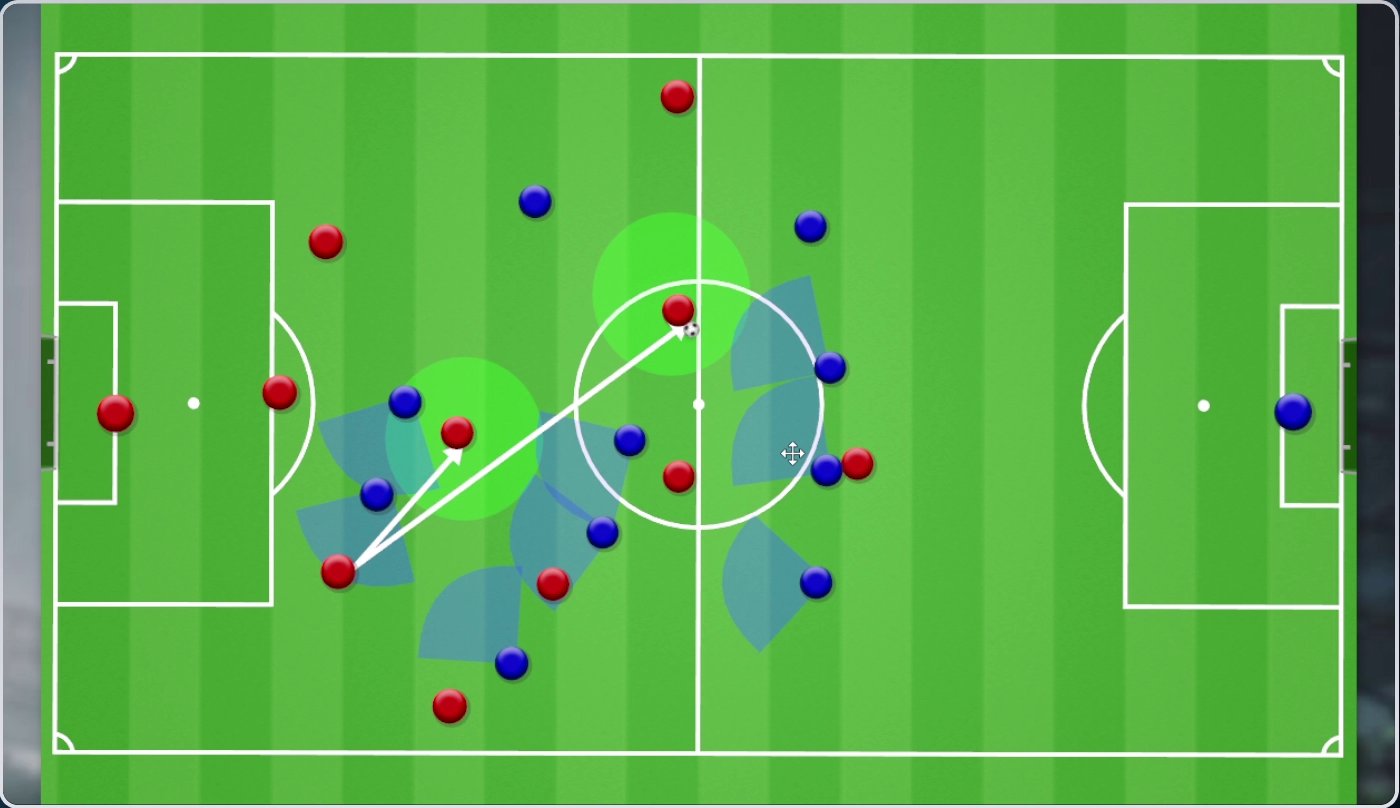
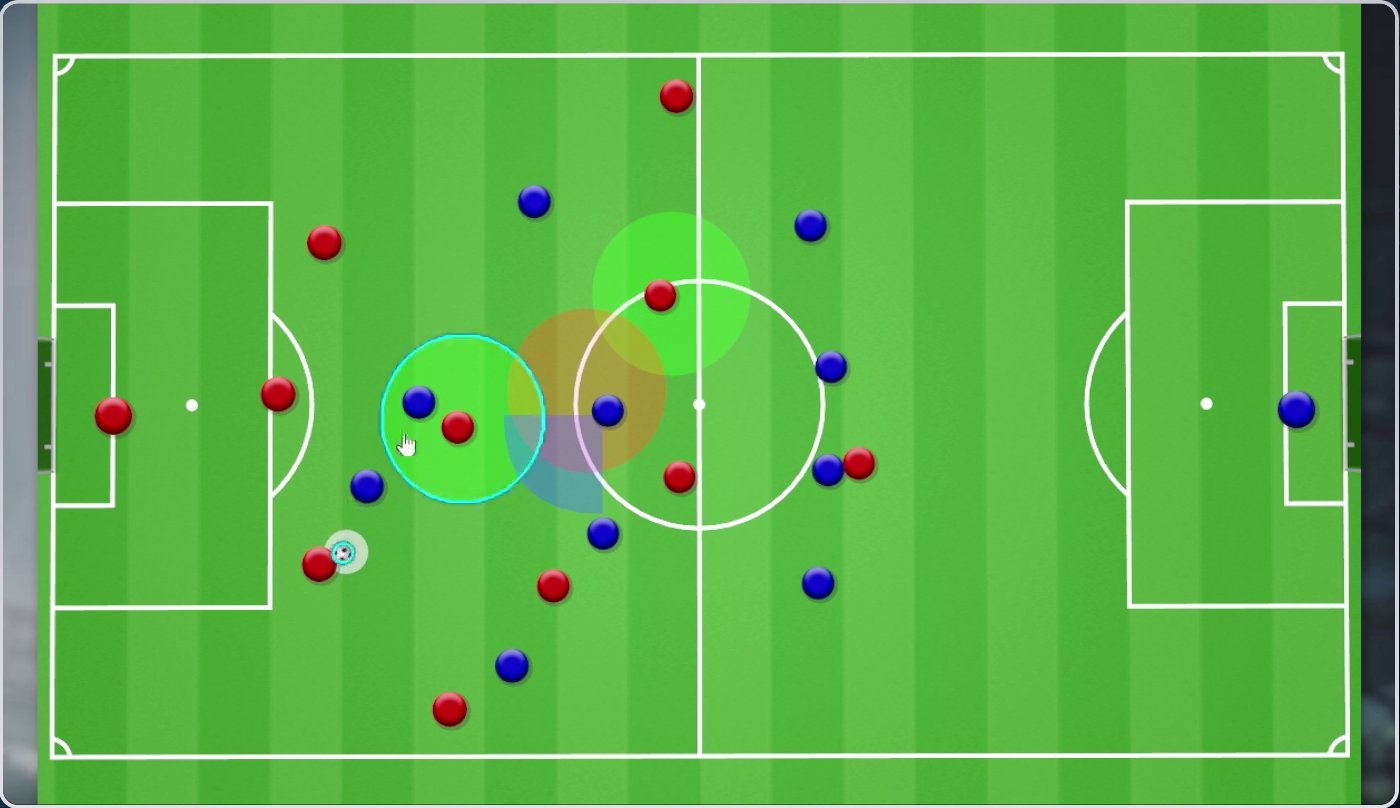
Drawn on the board, seen in real games
Each principle is built on the tactic board, piece by piece, and then checked against real game examples.
What coaches said after the webinar
“Good webinar, very clear and practical principles that can be applied to any system or style of play. Good course design.”
“Good and simple explanations about the basics, very good to transfer to the own tactical board and the pitch.”
“Very enjoyable and informative webinar, I took a lot from it. Showing examples of professional teams performing the principles is very helpful.”
“Great detailed logical objective content.”
Where it fits, and where it doesn't
- Your team builds up from the back and you want the build-up to lead somewhere
- You want your players to read the same cue at the same moment
- You want images and questions you can take straight to your players
- You're looking for a library of drills. Part 2 has 10 exercises, but this is about reading the game
- You want a set play-by-play for one formation. The examples use a 3-4-3, and the principles are meant to be adapted
Three ways in, one PDF to keep
Prices are set. The buttons appear when it opens.
- The webinar, 12 videos (2h 15m) with notes for every principle, for 1 year
- The ebook as a downloadable PDF, yours to keep
- $30 coupon for any Final Third courseBonus
$30 more than 4 months: eight more months of the webinar, and a PDF you keep after your access ends.
- The webinar, 12 videos (2h 15m) with notes for every principle, for 4 months
- The ebook, read online inside the course
- $30 coupon for any Final Third courseBonus
- The ebook: 11 chapters, one per webinar video, and the 10 exercises
- Read online inside the course, for 1 year
One payment. No subscription, nothing renews. Access starts the day you buy.
The $30 coupon for any Final Third course comes with the two webinar plans.
Questions
My team doesn't play a 3-4-3. Is it for me?
What's the difference between reading the ebook online and the PDF?
What does the ebook add to the webinar?
What happens when my access ends?
What can I use the $30 coupon on?
Why does it close?
Bernat Mosquera

Easy coaching for complex football
I'm Bernat Mosquera, with 4+ years as a Performance Individual Analyst working with professional players in La Liga. My work across 3 continents and 5 countries taught me one thing: at every level, we have to make the game simple to teach and effective to learn.
Three days, then it closes for six months.
Start with Chapter 3. You'll be on the list, and in 24 hours before everyone else.
Your build-up should end facing their goalkeeper.
Over two hours of webinar: 9 principles on the tactic board, real game examples for each one, and 10 progressive drills. Now with the ebook. Open until Thursday, October 22. Then it closes for six months.
2h 15m of webinar, 9 principles, real game examples, and the ebook. Closes Thu, Oct 22, then not for six months.
A one-minute clip from the webinar: close near, far deep.
Built by a Performance Individual Analyst working with professional players in La Liga, currently with an international with 50+ caps.
Lots of passes. Few chances.
- Your team keeps the ball in the build-up, and spends too much time there.
- Your 6 shows for the ball straight in front of the center back, and one straight run from their midfielder wins it back.
- Your striker makes the movement too early, and the pass never comes.
From the sideline it looks like a technique problem, or an effort problem. Most of the time it's a reading problem: the players don't see the same picture at the same moment.
This webinar gives them that picture, from the first pass to the chance.
Nine principles, from the build-up to the scoring chance
Over two hours of webinar on the tactic board, built on a 3-4-3. Each principle is explained, drawn, and then shown in real game examples, so your players see it happen in a match, not only on a board.
- 2h 15m of webinar in 12 videos, every principle on the tactic board
- Real game examples for each principle: what it looks like when a team does it in a match
- 9 clear and practical principles, references your players can see: the ball, teammates, opponents, space and time
- Notes for every principle, to review the key ideas without rewatching the whole video. See an extract.
- 10 progressive drills to take the ideas onto the pitch
Introduction · The Game2 videos · 33:38
- Why do we Build Up?16:46
- The Opposing Team16:52
Collective Principles · Build Up to Scoring Chance4 videos · 1:01:47
- 1. Diagonal over Vertical Chapter 3 free25:17
- 2. Open Ball Situations22:31
- 3. Prioritizing Movements6:24
- 4. Near Close & Far Deep7:35
Collective Principles · Facing the Backline5 videos · 37:31
- 5. The 3 Channels6:24
- 6. Don't Stop the Attacking Flow7:13
- 7. Attack to Score or Pin6:17
- 8. Space Behind over In Front6:34
- 9. Attack and Compact11:03
Drills Progression1 video · 2:40
- 10 Progressive Drills2:40
The webinar, written down. Eleven chapters, one for each lesson, for the coach who has to explain it on Tuesday:
- Every situation redrawn on a clean pitch, with a key to read it
- A Cue → If → Then card for each situation
- What to ask your players, how to correct the team, and a three-question test per chapter
- Part 2, Implementation: the 10 exercises, each tied to the chapter it trains
Every principle comes with its notes
You don't need to rewatch a whole video to remember it. Each principle video has its own page of notes: the idea, the positions, the why, and one question to check it on the pitch. This is a short extract from principle 4.
Webinar · Chapter 6 · Principle 4
Close-Near and Far-Deep
A position to attract and a position to attack. Your two wing-backs never have the same job, because they are never at the same distance from the ball.
Close-near: the ball-side wing-back |
When the ball is with the center-back, the ball-side wing-back is one of the nearest options. His role is to help the build-up: receive and connect with the players who can drive the attack. Around him, the ball-side 10 is in the vertical axis, so his reception is hard; most of the time he comes to receive at different heights and plays back to the opposite 6. The ball-side players attract so that the space grows for the bigger connectors: the opposite 6, ideally the opposite 10, or the striker.
His position: sometimes in front of the winger, sometimes a little behind him, but away from the fullback, so the fullback doubts whether to press and the 2v1 appears.
Far-deep: the opposite wing-backThe only player who must be very deep: on the limit of the backline. |
| 1 | Why Once you connect in behind on the ball side, the easiest finish is the early cross to the far side. He is the one who arrives and scores. |
Drawn on the board, seen in real games
Each principle is built on the tactic board, piece by piece, and then checked against real game examples.
What coaches said after the webinar
“Good webinar, very clear and practical principles that can be applied to any system or style of play. Good course design.”
“Good and simple explanations about the basics, very good to transfer to the own tactical board and the pitch.”
“Very enjoyable and informative webinar, I took a lot from it. Showing examples of professional teams performing the principles is very helpful.”
“Great detailed logical objective content.”
Where it fits, and where it doesn't
- Your team builds up from the back and you want the build-up to lead somewhere
- You want your players to read the same cue at the same moment
- You want images and questions you can take straight to your players
- You're looking for a library of drills. Part 2 has 10 exercises, but this is about reading the game
- You want a set play-by-play for one formation. The examples use a 3-4-3, and the principles are meant to be adapted
Three ways in, one PDF to keep
Same webinar, same ebook. Choose how long you want it, and whether you want the PDF.
- The webinar, 12 videos (2h 15m) with notes for every principle, for 1 year
- The ebook as a downloadable PDF, yours to keep
- $30 coupon for any Final Third courseBonus
$30 more than 4 months: eight more months of the webinar, and a PDF you keep after your access ends.
Get 1-year access + PDF$97 · one payment- The webinar, 12 videos (2h 15m) with notes for every principle, for 4 months
- The ebook, read online inside the course
- $30 coupon for any Final Third courseBonus
- The ebook: 11 chapters, one per webinar video, and the 10 exercises
- Read online inside the course, for 1 year
One payment. No subscription, nothing renews. Access starts the day you buy.
The $30 coupon for any Final Third course comes with the two webinar plans.
Why it closes
This webinar isn't part of the regular catalog. I open it for a few days, and then I close it. The last time it was closed for six months.
On Thursday, October 22 at 11:59 PM Eastern it closes again, and it reopens in six months.
Questions
My team doesn't play a 3-4-3. Is it for me?
What's the difference between reading the ebook online and the PDF?
What does the ebook add to the webinar?
What happens when my access ends?
What can I use the $30 coupon on?
Why does it close?
Bernat Mosquera
Easy coaching for complex football
I'm Bernat Mosquera, with 4+ years as a Performance Individual Analyst working with professional players in La Liga. My work across 3 continents and 5 countries taught me one thing: at every level, we have to make the game simple to teach and effective to learn.
Open until Thursday night.
Closes Thursday, October 22 at 11:59 PM Eastern.
Closed. It reopens in six months.
Build Up to Scoring Chance was open for three days in October 2026. Read Chapter 3 of the ebook free in the meantime, and you'll be the first to know when it reopens.
Built by a Performance Individual Analyst working with professional players in La Liga, currently with an international with 50+ caps.
Read Chapter 3 while it’s closed
Your 6 keeps coming to the ball, straight in front of the center back, back to goal. From the sideline you hear “Show for it!” The pass goes in, one straight run from their midfielder, and the ball is gone.
Which pass makes their defenders turn their heads?
- Three situations, each with its own image and Cue → If → Then card
- What to ask your players, and how to correct the team
- A three-question test to check your reading
Nine principles, from the build-up to the scoring chance
Over two hours of webinar on the tactic board, built on a 3-4-3. Each principle is explained, drawn, and then shown in real game examples, so your players see it happen in a match, not only on a board.
- 2h 15m of webinar in 12 videos, every principle on the tactic board
- Real game examples for each principle: what it looks like when a team does it in a match
- 9 clear and practical principles, references your players can see: the ball, teammates, opponents, space and time
- Notes for every principle, to review the key ideas without rewatching the whole video. See an extract.
- 10 progressive drills to take the ideas onto the pitch
Introduction · The Game2 videos · 33:38
- Why do we Build Up?16:46
- The Opposing Team16:52
Collective Principles · Build Up to Scoring Chance4 videos · 1:01:47
- 1. Diagonal over Vertical Chapter 3 free25:17
- 2. Open Ball Situations22:31
- 3. Prioritizing Movements6:24
- 4. Near Close & Far Deep7:35
Collective Principles · Facing the Backline5 videos · 37:31
- 5. The 3 Channels6:24
- 6. Don't Stop the Attacking Flow7:13
- 7. Attack to Score or Pin6:17
- 8. Space Behind over In Front6:34
- 9. Attack and Compact11:03
Drills Progression1 video · 2:40
- 10 Progressive Drills2:40
The webinar, written down. Eleven chapters, one for each lesson, for the coach who has to explain it on Tuesday:
- Every situation redrawn on a clean pitch, with a key to read it
- A Cue → If → Then card for each situation
- What to ask your players, how to correct the team, and a three-question test per chapter
- Part 2, Implementation: the 10 exercises, each tied to the chapter it trains
Every principle comes with its notes
You don't need to rewatch a whole video to remember it. Each principle video has its own page of notes: the idea, the positions, the why, and one question to check it on the pitch. This is a short extract from principle 4.
Webinar · Chapter 6 · Principle 4
Close-Near and Far-Deep
A position to attract and a position to attack. Your two wing-backs never have the same job, because they are never at the same distance from the ball.
Close-near: the ball-side wing-back |
When the ball is with the center-back, the ball-side wing-back is one of the nearest options. His role is to help the build-up: receive and connect with the players who can drive the attack. Around him, the ball-side 10 is in the vertical axis, so his reception is hard; most of the time he comes to receive at different heights and plays back to the opposite 6. The ball-side players attract so that the space grows for the bigger connectors: the opposite 6, ideally the opposite 10, or the striker.
His position: sometimes in front of the winger, sometimes a little behind him, but away from the fullback, so the fullback doubts whether to press and the 2v1 appears.
Far-deep: the opposite wing-backThe only player who must be very deep: on the limit of the backline. |
| 1 | Why Once you connect in behind on the ball side, the easiest finish is the early cross to the far side. He is the one who arrives and scores. |
What coaches said after the webinar
“Good webinar, very clear and practical principles that can be applied to any system or style of play. Good course design.”
“Good and simple explanations about the basics, very good to transfer to the own tactical board and the pitch.”
“Very enjoyable and informative webinar, I took a lot from it. Showing examples of professional teams performing the principles is very helpful.”
“Great detailed logical objective content.”
Bernat Mosquera
Easy coaching for complex football
I'm Bernat Mosquera, with 4+ years as a Performance Individual Analyst working with professional players in La Liga. My work across 3 continents and 5 countries taught me one thing: at every level, we have to make the game simple to teach and effective to learn.